
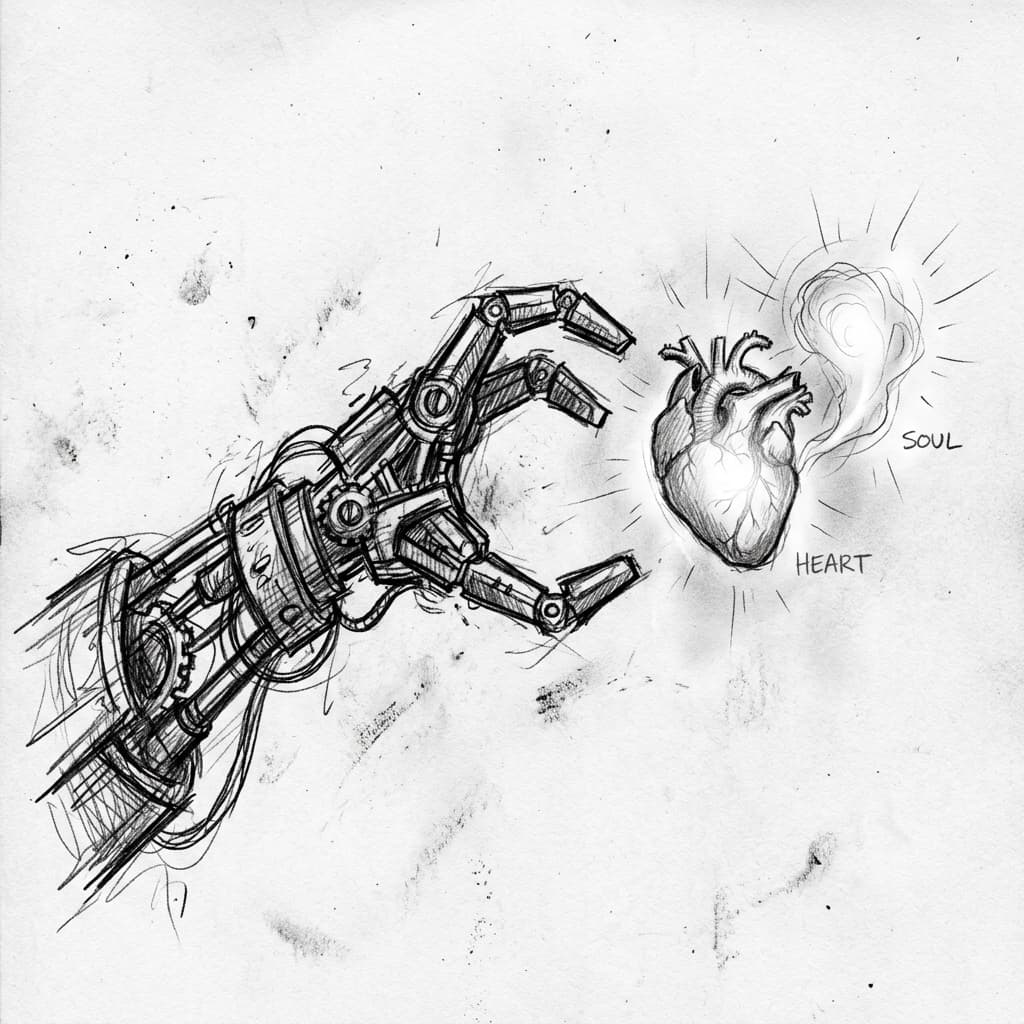
On Friday, 21 August, in the Clementine Hall of the Apostolic Palace, Leo XIV received the participants of the seventeenth annual meeting of the International Catholic Legislators Network, an organisation of serving parliamentarians from many countries whose Roman gathering this year, held from 20 to 23 August, carried a title that explains the interest of the address by itself: human dignity and artificial intelligence, challenges, chances and control. Cardinals Christoph Schönborn, Béchara Boutros Raï and Charles Maung Bo were present as patrons of the network. The audience, in other words, was not a general audience or a group of pilgrims. These were legislators in office, people who draft and vote on statutes, and the address was pitched to them with a precision worth examining before it is summarised.
The image that led the headlines was the most literary one. Humanity, he said, may build a new Tower of Babel, where power, efficiency and control obscure the face of the human person; or it may build a civilisation in which technology serves the integral development of the person. It is an effective metaphor and it travelled well through the press, as metaphors tend to. But the passage that deserved the headline came a few lines later, and it is the one most of the coverage trimmed.
Speaking of the family — which he called the first school of humanity, the place where trust, generosity and dialogue are learned — the Pope named three specific ways in which artificial intelligence might erode it. Two of them appeared in nearly every report: reducing persons and their relationships to data and simulations, and flooding young minds with content that distorts desire. The third dropped out of most summaries. The full sentence warns that artificial intelligence must never be allowed to erode this primary cell of society, whether by reducing persons and relationships to data and simulations, by flooding young minds with content that distorts desire, or by economic models that make family life economically precarious.
The difference between those three clauses is worth dwelling on, because they are not of the same kind. The first two are anthropological and moral warnings: they hold that something in our dealings with machines impoverishes the human way of forming bonds. They can be argued with, but the argument takes place in the register of values, which is where the public expects to find a pontiff and where, consequently, his intervention is predictable and easily filed away. The third clause is of another order altogether. It asserts that there exist economic models — not private vices, not a loosening of manners, but architectures of market and employment — that make forming and sustaining a family materially unviable. That is an empirical proposition. It can be measured. It is measured in the ratio between the price of a dwelling and the median wage of a thirty-year-old, in the share of contracts that make next month's income unforeseeable, in the age at which people have a first child, and in the gap between the number of children people say they want and the number they actually have. Every statistical office in every developed country publishes those series.
The same reasoning returned when he turned to work, and there the formulation was blunter still: he described models in which the dignity of workers is subordinated to the optimisation of systems, and identified in them subtle forms of technological domination. Notice what that sentence does not say. It does not say that automation destroys jobs, which is the customary complaint and the easiest to answer. It says something more uncomfortable: that the criterion by which work is organised has become the efficiency of the system, and that the person is fitted to that criterion rather than the reverse. Anyone who has watched an algorithm assign shifts, time breaks and score performance grasps the reference immediately, without needing to share any religious premise whatever.
Which is why the passage addressed specifically to the legislators carries more operational content than it was granted. Sound legislation, he argued, should encourage scientific and technological creativity while safeguarding fundamental rights and freedoms; it should protect users from exploitation, preserve personal privacy, ensure transparency in the use of emerging technologies, and guarantee that these strengthen democratic institutions rather than weaken them. He specified that this requires robust legal frameworks, independent oversight and informed users. The point, he said, is not to obstruct innovation but to guide it prudently. The formulation is concrete enough to be set against what is actually before the world's parliaments: independent oversight means a body with its own budget and powers of inspection, not an advisory committee; transparency means being able to learn what data trained a system that decides something about a person; informed users means the information arriving before the signature rather than in a forty-page document after it.
The obvious objection deserves an answer before someone else frames it. It will be said that a head of state with two millennia of institution behind him has every incentive to distrust a technology that reorders authority over knowledge, and that his warnings should be read in that light. The observation is fair and it changes nothing, because the origin of a claim does not settle its truth. If economic models that make family life precarious exist, they will exist whether a pontiff says so or a statistical institute does; and if they do not exist, no moral authority will conjure them. The only way to settle it is to consult the series — which is precisely what the omitted clause invites and what its omission prevents.
That is the practical effect of the cut, and it was probably not deliberate. When two moral clauses survive and the economic one is lost, the whole address is reclassified: it ceases to be an intervention in public policy, arguable with figures, and becomes a spiritual exhortation that each reader files according to prior affinity. The believer nods, the indifferent turns the page, and nobody has to go and look up the housing data. The clause that fell away was the one obliging a legislator to do something checkable with what he had just heard.
There remains the sentence he closed with, which states the criterion entire: the world does not need an artificial intelligence that diminishes humanity, but a human intelligence enlightened by wisdom, a political authority guided by conscience, and a technological innovation directed by charity. It sounds like chancery prose, and in part it is, but it carries an identifiable thesis: that the problem of technique is not solved inside technique. No safety mechanism within a system decides what that system is for; that decision always happens outside it, in the head of someone who already holds a criterion, which is why the quality of the criterion matters more than the quality of the mechanism.
The parliamentarians who heard the address now return to their chambers, where bills on artificial intelligence are in progress in nearly every country represented in the hall. What will be worth checking a year from now is not how many quoted the Tower of Babel in a campaign speech, which will be several, but how many tabled an amendment on independent oversight, on the disclosure of training data, or on scheduling rights in algorithmically managed employment. The third clause, the one that fell out of the coverage, is the only one of the three that can become an article of a statute. Which is exactly why it was worth keeping.
Legal Notice: This critical analysis is published under Art. 28 (news of general interest) and Art. 10 (right of quotation) of Law 11.723 on Intellectual Property of the Argentine Republic. The original work and its title belong to their respective author and publisher, both cited on this page.