
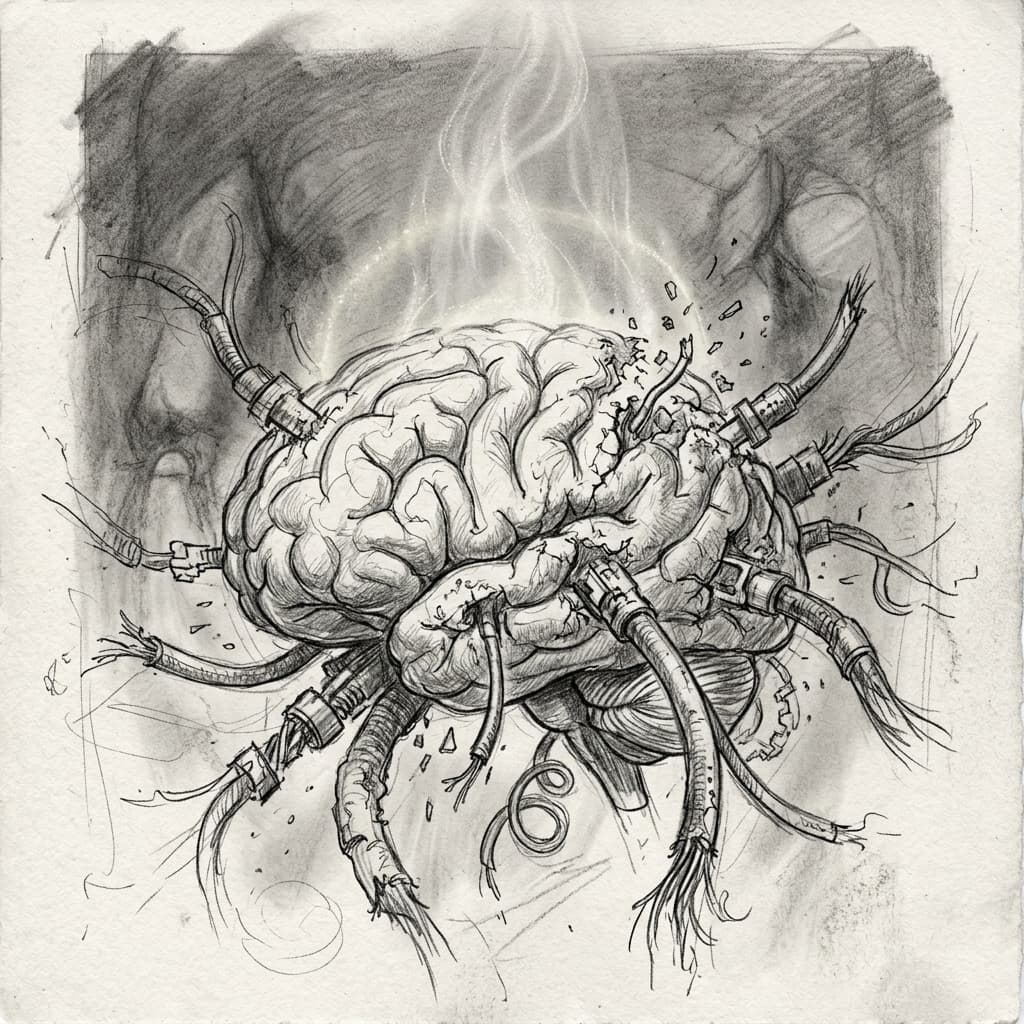
We live in an age dazzled by its own silicon reflections. The recent promises emanating from the technological epicenters of Silicon Valley claim, with an arrogance that borders on philosophical ridicule, that we are on the eve of the "singularity." They assure us that, through neural implants and brain-computer interfaces, humanity will soon be able to merge with artificial intelligence and ultimately "download" individual consciousness to cloud servers to achieve cybernetic immortality.
As a scientist dedicated to the study of the human brain, I must warn that such a claim is not bad science; It is, quite simply, a terrible philosophy disguised as neurobiology. Transhumanism is based on a fatal categorical error: it assumes that the human being is an algorithm and that the brain is merely a hard drive of flesh. From this materialist view, thoughts, memories, acts of free love, and the pain of guilt would be nothing more than epiphenomena, the chemical friction resulting from the synchronized firing of neurons.
However, classical Aristotelian-Thomistic metaphysics inoculates us against this Promethean delusion. The human person is a substantial unity of body and spiritual soul. The intelligence capable of abstracting universals and the free will capable of tending towards good do not reside in the material substrate. The brain is the material condition necessary for the ordinary exercise of our faculties in this world, in the same way that a piano is necessary for the pianist to perform the sonata; but the symphony is not trapped in the keys.
To believe that by mapping each electrical synapse you can capture the "I" is to incur the crudest reductionism. The "Hard Problem of Consciousness" continues to be a granite wall against which transhumanists crash. Machines compute, process, and simulate, but they do not "experiment." They lack interiority.
The attempt to dump an immortal soul into a pendrive is the last and saddest attempt of immanentism to avoid the question of the Final Judgment and the Creator. It's time to regain rigor: the medical technique that repairs a damaged brain is a noble act of charity; but the ideology that seeks to turn man into a transistor deity is the technological reissue of the old temptation of Eden. The human soul is neither plugged in nor unloaded; It infinitely transcends all matter in the visible cosmos.
Legal Note: This critical analysis is carried out under the protection of Art. 28 (news of general interest) and Art. 10 (right of citation) of Law 11,723 on Intellectual Property of the Argentine Republic. The original work and its title belong to its respective author and publication medium, cited on this page.