
The contemporary world, anesthetized by the dazzling advance of material technology, has succumbed to one of the grossest and most harmful intellectual superstitions in human history: scientism. This aberration of thought postulates that the only valid form of knowledge is that which comes from the empirical scientific method.
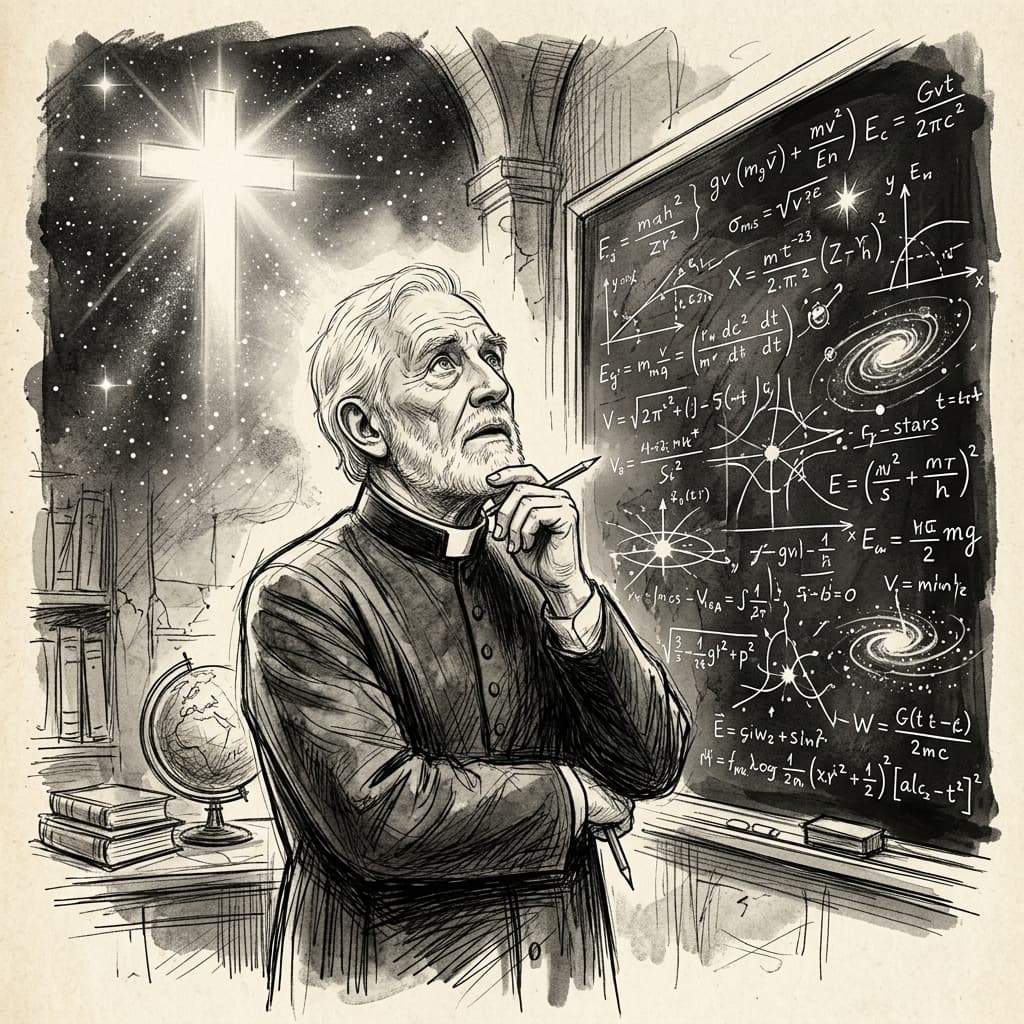
To combat this arrogant myopia and restore epistemological rigor, few minds in the last century have been as lucid, relentless and crystalline as that of Father Dr. Manuel Carreira S.J., theologian, philosopher and eminent astrophysicist. From the heart of the Catholic faith and with a scientific mind of the first order, Father Carreira dedicated his life to destroying, with iron logic, materialist reductionisms.
Given the extensive and profound nature of his thoughts, masterfully presented in his multiple interventions, we have decided to structure this tribute in an interview format divided into four parts. It is important to clarify to our readers that we are not really interviewing Father Carreira in person, but rather we are conducting a conceptual interview with his video conference on the limits of science to explain his position in a didactic manner. The answers recorded here have been extracted with total literalness and accuracy from the first 33 minutes of his masterful presentation.
Below, we offer our readers the audiovisual document that motivates this exhaustive analysis:
Dr. María Victoria Ibáñez-Soto: Father Carreira, it is an immense honor. The modern debate usually presents us with a fictitious dichotomy: either one is scientific and rational, or one is a believer. Many popularizers assume the spokesperson for deep mysteries, hiding only behind their test tubes. How should we truly address the big questions about reality fully?
Father Dr. Manuel Carreira: "If I want to explain something completely, what a physicist or a chemist tells me is not enough. There are many questions in which science, theology and philosophy seem united and in which the three ways of speaking are necessary to deal with very complex topics."
Dr. Ibáñez-Soto: Entering fully into the great cosmic enigma, the origin of everything. Many contemporary materialists and atheists posit that matter and energy have simply existed forever. What does philosophical reason require of us about the existence of the universe?
Father Dr. Manuel Carreira: "What does not exist cannot give existence to itself. The existence of the universe cannot be explained except as creation and if the universe is not eternal then how did it begin?"
Dr. Ibáñez-Soto: Precisely for a long time, even renowned scientists thought it was obvious that the universe and space had always existed in a stationary state. What has modern astrophysics shown us about this supposed eternity of the cosmos?
Father Dr. Manuel Carreira: "For a long time people have thought it obvious that the universe has always existed, but science is precisely what leads us to say: it cannot be. It cannot always have existed."
Dr. Ibáñez-Soto: If science forces us to categorically rule out an eternal universe, what empirical discoveries have led us to understand how it all began and what that primordial universe was like?
Father Dr. Manuel Carreira: "The universe today is expanding, it is a fact that has been known since approximately 1920... if the universe is expanding, that means that before it was smaller and going backwards there must come a time when the entire universe occupied perhaps less space than an apple, than an atom. And what was the universe like then? Physics calculations tell me that it had to be enormously hot and enormously dense, and that there was a kind of big explosion."
Dr. Ibáñez-Soto: The question that instinctively arises at the idea of this initial "big explosion" is about what existed before it. What does strict scientific rigor tell us about this material "before" and about the spatial coordinates of this event?