
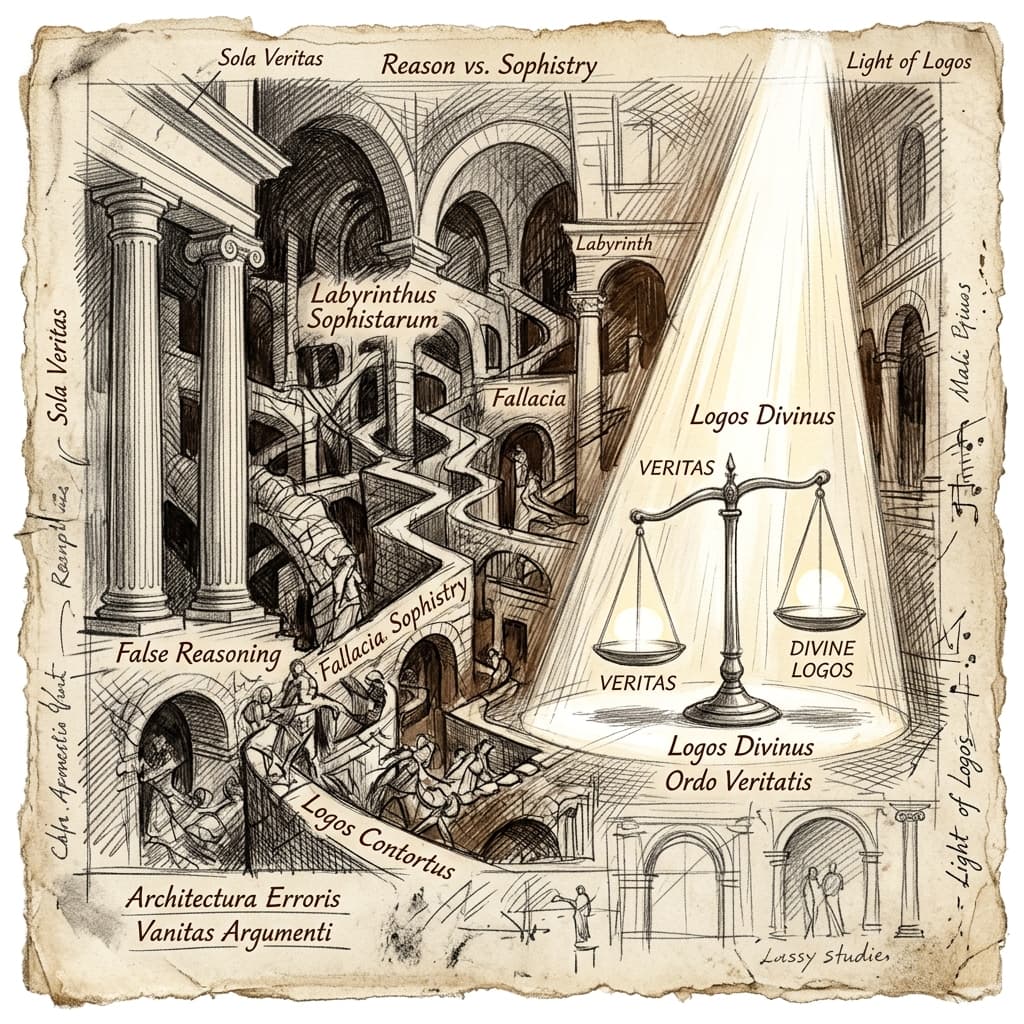
We begin in the pages of this publishing house a great intellectual, scientific and spiritual journey aimed at purifying the public and private debate of the ideological mists that today suffocate the civilizing life of the West. Throughout six monumental installments, our board of directors and body of researchers will subject Ricardo García Damborenea's portentous Dictionary of Fallacies to a rigorous analytical and critical exegesis, an essential work to sanitize the dialectical customs of our time. In my capacity as General Director and Journalistic Editor, I confirm daily the pressing urgency of exposing the systematic lie that prevails in the international press and in parliamentary politics; At the same time, thanks to the contributions of our head of neuroscience, Dr. María Victoria Ibáñez-Soto, we observe with clinical fascination how our human brain—that prodigious synaptic network sculpted by the Creator and endowed with astonishing plasticity—is with alarming ease hijacked by heuristic shortcuts and cognitive illusions; and, from the perspective of classical anthropology and pre-conciliar pontifical theology that inspires our editorial line, we warn that the deliberate deviation from the truth does not constitute a mere categorical error or a technical failure of communication, but a direct offense to the rational order that God has imprinted on the universe.
The nature of false reasoning must be understood in its deepest teleological dimension. The arguments, in their purest conception and in accordance with their original purpose, have been given to man to support the truth, the verisimilitude or the convenience of good in the community of people. However, the inherited fragility of our human condition—coupled with the propensity of our neural networks to economize metabolic effort through accelerated associations—means that we frequently construct flawed inferences, aborting their noble discursive purpose. Worse still happens when, in an act of deliberate malice that darkens the soul and degrades the public space, men use apparent arguments with the perverse purpose of deceiving the masses, distracting the adversary in parliamentary debate or morally disqualifying their neighbor. We call all these forms of argumentation that contain errors in logical processing or pursue spurious ends. The terminology has an illustrious and venerable philological ancestry: it comes from the Latin word fallatia, which unequivocally expresses the action of deception, and is used in the scholastic tradition as a precise synonym for sophistry, that coinage of the wise men of Hellas to designate the trickery of the false philosopher. From the neurobiological level, the fallacy acts as a carefully profiled stimulus to evade the analytical scrutiny of the dorsolateral prefrontal cortex—the seat of logical deliberation and tempered judgment—and directly impact the limbic system and the cerebral amygdala, thus governing the disordered passions of the audience.